Basics


Info Download

Advanced

v/v
V
V

Plot Download

Asce 7 22 Portable May 2026

The wind speed maps have been recalibrated. A Risk Category II portable building in Houston, TX, now requires design for 150 mph (instead of 140 mph in ASCE 7-16). If you are using an old "portable wind calculator" app—throw it away. Part 3: Wind Loads on Portable Structures (Chapter 26 & 29) This is the heart of the matter. A portable structure behaves differently than a permanent building because it has gaps, tow bars, exposed chassis, and—critically—no rigid connection to the earth. 3.1 Main Wind Force Resisting System (MWFRS) vs. Components & Cladding (C&C) For a portable unit, the MWFRS is the steel skid or chassis. The C&C includes the lightweight walls and roof.

Design every portable unit as if it will be anchored in the worst possible location—because eventually, it will be. Disclaimer: This article is for informational purposes. Always consult a licensed structural engineer and the full ASCE 7-22 standard for your specific portable structure application.

The release of brought a seismic shift (literally and figuratively) to the engineering world. While most engineers immediately focused on the changes to wind speeds, seismic maps, and tsunami loads, a growing sector of the industry has been asking a critical question: How do these new provisions apply to portable buildings? asce 7 22 portable

However, beware: If your portable unit is stacked (two-story portable office), the 7-22 code prohibits the free-rocking exception. Stacked portables must be treated as fixed-base structures with explicit seismic connections. Inside a portable building, everything moves: server racks, lockers, medical equipment, and furniture. ASCE 7-22 Section 13.2.1 now requires that portable structures with casters or wheels have all internal components independently braced for ( F_p = 0.6 S_DS W_p ) (up from 0.4 in 7-16). This is a 50% increase in internal bracing loads.

Whether you are designing a portable command center for disaster recovery or a simple job site lunchroom, remember: The wind speed maps have been recalibrated

ASCE 7-22 introduces based on updated maps (incorporating the 2018 NSHMP model). For portable structures: 4.1 The "Free Rocking" Exception Portable structures mounted on elastomeric pads or wheels are considered "self-centering" if their height-to-width ratio is < 0.5. For these units, ASCE 7-22 allows a reduced seismic response coefficient (R = 4) instead of the standard R = 1.5 for non-ductile portable buildings.

If you are a portable classroom manufacturer: Your whiteboards, bookshelves, and overhead projectors must now be seismically restrained—even in low-seismic regions—if the unit is ever deployed to a higher seismic zone. ASCE 7-22’s load combinations (Chapter 2) apply universally, but the transient nature of portable structures requires a nuanced take. Part 3: Wind Loads on Portable Structures (Chapter

ASCE 7-22 Table 1.5-1 outlines four Risk Categories (I, II, III, IV). For portable units:
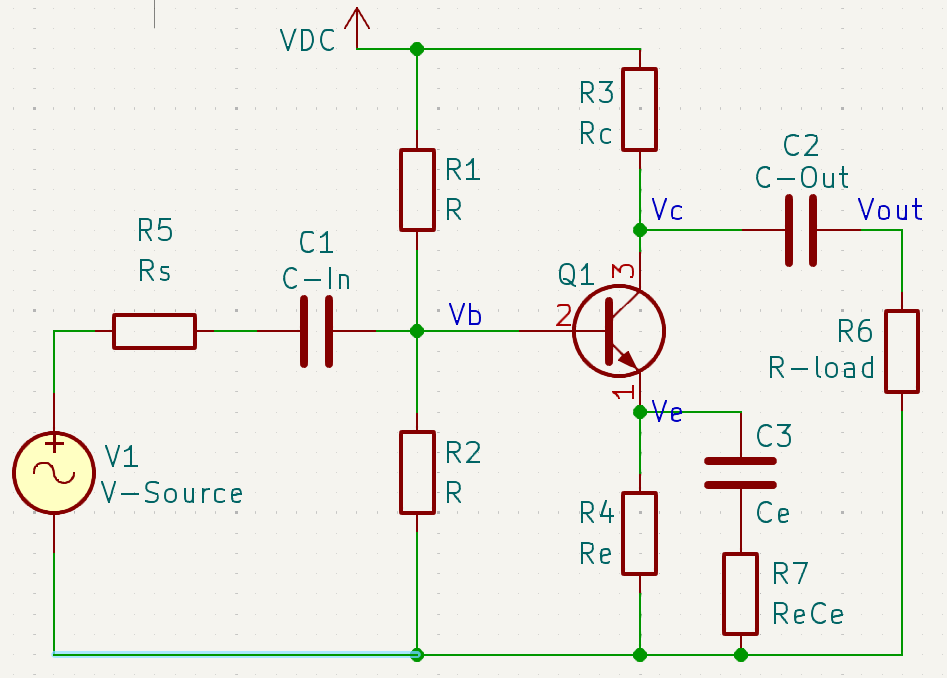
Disclaimer: This tool is provided for educational and illustrative purposes only. No guarantee is made regarding accuracy, suitability, or performance. Use at your own risk. - Copyright: ufelectronics.eu / Andreas Dyhrberg

×
Amplifier Schematic
×

There are different ways to calculate an amplifier, depending on what you want to achieve.

Maybe you want to achieve a certain gain, as far as possible (classic mode). Or you have a low Vcc to respect (modern mode). Or you work with analog audio amps (symmetry mode).

Depending on what you want to achieve and the way of calculating it. Some fields might become dependent on others, or the other way around.

Your above choise makes some input fields available for manipulation, while hiding others.


🎯 1. Target Gain (Av) — "Classic mode"

You care about how much your amplifier multiplies the input signal.

Set desired voltage gain and Rc voltage drop. Best for learning and simple amplifiers.

You say: “I want a gain of 10.”
The app adjusts resistors to try and match that.
You must give Av and Vrc (the voltage dropped across Rc).

Best for common emitter amplifiers.

✅ Default choice for most beginners and educational use.


⚡ 2. Target Emitter Voltage (Ve) — "Modern mode"

You care about setting a healthy DC bias point.

Prioritize stable biasing via Ve. Useful for low-voltage circuits or precision designs.

You say: “I want Ve = 0.5 V, to keep the transistor out of trouble.”
This makes sure your transistor stays in active mode.
Gain becomes whatever it turns out to be.

Ideal for common emitter amplifiers when the goal is to ensure proper biasing for low-voltage or precision circuits, and it’s also used in class AB amplifiers to prevent distortion

✅ Useful in low-voltage designs (e.g., 3.3V systems).


🧭 3. Target Collector Voltage (Vc) — "Symmetry mode"

You want to place the collector in the middle of the power rail.

Target Vc = Vcc/2 for maximum signal swing. Great for audio and analog signals.

You say: “Make Vc = Vcc/2” for maximum swing.
Useful for analog audio amps or symmetrical headroom.
Gain and Ve are outcomes.

Best for common collector amplifiers and class AB amplifiers.

✅ Best for signal integrity.

×

Features and Requirements

✅ Functional Features

  • Support for Four Amplifier Types
    • Common Emitter (CE)
    • Common Collector (CC)
    • Common Base (CB)
    • Class AB (AB)
  • Constraint Modes
    • Target Gain (Av) – “Classic mode”
    • Target Emitter Voltage (Ve) – “Modern mode”
    • Target Collector Voltage (Vc) – “Symmetry mode”
  • Input Parameters
    • Vcc, Ic, β (gain), Rs, Rl
    • Ve, Vc, Av, Vrc (depending on mode)
    • Divider current ratio
    • Transistor model selection
    • Resistor series (E12, E24, E96)
    • Target low cutoff frequency
    • Bypass capacitor selection (Yes/No)
  • Calculation Features
    • Resistor values (Rc, Re, R1, R2)
    • Input and output impedance (Zin, Zout)
    • Voltage gain, overall gain
    • Maximum input/output swing
    • Capacitor sizing: Cin, Cout, Cbypass
    • Support for standard resistor rounding and color band visualization
    • Model-aware parasitic capacitance (Cbe, Cbc) and effect on fc

✅ Educational Features

  • Visual Feedback
    • Schematic changes with amplifier type
    • Constraint mode helper and long explanation section
    • Graphs: gain vs frequency, swing diagram
  • User Interface Enhancements
    • Responsive layout
    • Constraint help tooltip
    • Collapsible “Longer Explanation” for constraint modes
    • Zoom controls
    • Dynamic timestamping for exports
  • Export and Print Features
    • CSV/XML export
    • Clipboard copy of results
    • Resistor and capacitor export
    • Print-friendly layout